Long-Radius Induction Bends
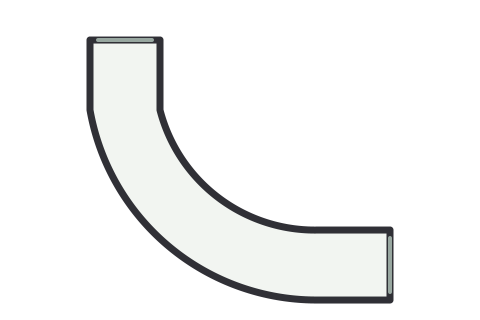
Large-radius induction bends formed by localised induction heating to ASME B16.49 / ISO 15590-1 for carbon and low-alloy pipeline steel; other alloys to project specification.
Technical specification
| Parameter | Specification |
|---|---|
| Product | Long-radius induction bends — a mother pipe (seamless or welded) formed by localised induction heating to the approved drawing |
| Bend standard | ASME B16.49 (carbon-steel pipeline) · ISO 15590-1 (unalloyed / low-alloy, by PSL); other alloys to project specification |
| Radius & angle | 3D–10D centreline radius (D basis stated on the drawing); angle & tangents to drawing |
| End preparation | Bevel to ASME B16.25 where specified |
| Size range | 2"–60" NPS; qualified size × wall × radius combinations confirmed per order |
| Mother pipe | API 5L / ISO 3183 or the applicable pipe spec, grade, PSL & delivery condition — an input to the finished-bend qualification |
| Finished wall | Design minimum wall, extrados thinning & ovality per the applicable standard / project code — not the nominal starting schedule |
| Sour service | NACE MR0175 / ISO 15156 where specified (by grade, condition & HAZ) |
| Documentation | EN 10204 3.1 / 3.2, PMI, TPI |
How it is made
Long-radius induction bends are formed by heating a narrow circumferential band of the mother pipe with an induction coil and bending the pipe through that band as it advances, giving a controlled centreline radius. The starting pipe (seamless or welded) is verified before bending; after forming, the bend is heat treated as required for the grade — normalised, normalised & tempered or quenched & tempered for carbon and low-alloy pipeline steels — then end-prepared and inspected to the approved drawing. Extrados thinning, intrados thickening and ovality are checked against the design, and starting-pipe certification does not by itself qualify the finished bend, which is tested to the applicable specification. Bends in stainless, duplex, nickel and other alloys follow a separately justified qualification and heat-treatment route.
Grades & materials
Representative mother-pipe grades for induction bends, with representative chemistry. The finished-bend grade, class and condition are qualified and confirmed per order; starting-pipe grades do not by themselves certify the finished bend.
| Material family | Grades | UNS | Standard | Service |
|---|---|---|---|---|
| Carbon steel | A234 WPB, WPC | — | ASME B16.9 / A234 | General |
| High-yield pipeline | A860 WPHY 42/46/52/60/65/70 | — | ASME B16.9 / A860 · MSS SP-75 | Pipeline |
| Cr-Mo alloy | A234 WP11, WP22, WP91 | — | ASME B16.9 / A234 | High-temperature |
| Austenitic stainless | A403 WP304/304L, 316/316L, 321, 347 | — | ASME B16.9 / A403 | Corrosion |
| Duplex / super duplex | A815 S31803 (2205), S32750 (2507) | — | ASME B16.9 / A815 | Chloride / sour |
| Nickel alloys | B366 WPNCI (600), WPNCMC (625), WPHC276 (C-276) | — | ASME B16.9 / B366 | Severe corrosion |
Chemical composition (representative)
| Grade | C | Mn | Si | Cr | Ni | Mo | Other |
|---|---|---|---|---|---|---|---|
| A234 WPB | 0.30 max | 0.29–1.06 | 0.10 min | — | — | — | — |
| A860 WPHY 52 | 0.22 max | 1.60 max | 0.45 max | — | — | — | Nb+V+Ti 0.15 max |
| A860 WPHY 65 | 0.22 max | 1.65 max | 0.45 max | — | — | — | Nb+V+Ti 0.15 max |
| A234 WP22 | 0.05–0.15 | 0.30–0.60 | 0.50 max | 1.90–2.60 | — | 0.87–1.13 | — |
| A403 316L | 0.030 max | 2.00 max | 0.75 max | 16.0–18.0 | 10.0–14.0 | 2.0–3.0 | — |
| A815 S32750 | 0.030 max | 1.20 max | 0.80 max | 24.0–26.0 | 6.0–8.0 | 3.0–5.0 | N 0.24–0.32 |
| B366 625 | 0.10 max | 0.50 max | 0.50 max | 20.0–23.0 | 58.0 min | 8.0–10.0 | Nb 3.15–4.15 |
Standards & specifications
Bend & pipeline standards
- ASME B16.49 carbon-steel pipeline induction bends
- ISO 15590-1 induction bends from unalloyed / low-alloy pipe (by PSL; 2024 edition supersedes 2018)
- API 5L / ISO 3183 mother-pipe grade, PSL & delivery condition
- ASME B16.25 weld-end preparation where specified
Material & service
- ASTM A234 / A860 carbon & high-yield mother pipe
- ASTM A403 / A815 stainless & duplex (to a separately justified qualification)
- ASTM B366 nickel alloys (project specification)
- Applicable B31 / project code for design pressure, minimum wall & temperature; NACE MR0175 / ISO 15156 by grade, condition & HAZ where specified
Mechanical properties (representative grades)
Representative grades — full MTC values on request. Values are ASTM/ASME specification minima or ranges at room temperature. These are mother-pipe specification values; finished-bend properties are verified after forming and heat treatment per the applicable specification.
| Grade | Type | Tensile (MPa) | Yield min (MPa) | Elong min (%) |
|---|---|---|---|---|
| A234 WPB | Carbon | 415–585 | 240 | 22 |
| A234 WPC | Carbon | 485–655 | 275 | 20 |
| A860 WPHY 42 | High-yield | 414 | 290 | per A860 |
| A860 WPHY 46 | High-yield | 434 | 317 | per A860 |
| A860 WPHY 52 | High-yield | 455 | 359 | per A860 |
| A860 WPHY 60 | High-yield | 517 | 414 | per A860 |
| A860 WPHY 65 | High-yield | 531 | 448 | per A860 |
| A860 WPHY 70 | High-yield | 565 | 483 | per A860 |
| A234 WP11 Cl.1 | 1¼Cr-½Mo | 415–585 | 205 | 20 |
| A234 WP22 Cl.1 | 2¼Cr-1Mo | 415–585 | 205 | 20 |
| A234 WP91 | 9Cr-1Mo-V | 585–760 | 415 | 20 |
| A403 WP304 / 304L | Austenitic SS | 515 / 485 | 205 / 170 | 35 |
| A403 WP316 / 316L | Austenitic SS | 515 / 485 | 205 / 170 | 35 |
| A403 WP321 / 347 | Austenitic SS | 515 | 205 | 35 |
| A815 WPS31803 (2205) | Duplex | 620 | 450 | 25 |
| A815 WPS32750 (2507) | Super duplex | 795 | 550 | 15 |
| B366 WPNCI (600) | Ni-Cr | 550 | 240 | 30 |
| B366 WPNCMC (625) | Ni-Cr-Mo | 760 | 345 | 30 |
| B366 WPHC276 (C-276) | Ni-Mo-Cr | 690 | 283 | 40 |
Testing, inspection & documentation
| Test / document | Detail |
|---|---|
| Chemical / PMI | Chemistry per the specification; PMI on alloy, stainless & nickel |
| Tensile | Tensile, yield and elongation per grade (A860 elongation by formula); test location in bend / tangent as the specification requires |
| Impact (Charpy) | Pipeline / low-temp grades at the specified test temperature & orientation |
| Hardness | Brinell / Rockwell; NACE MR0175 for sour service (base, weld & HAZ) |
| Wall & geometry | UT wall-thickness mapping, ovality, bend angle, centreline radius & tangent checks against the drawing |
| Qualification | Bending-procedure & test-bend qualification where the specification requires it; starting-pipe MTC does not qualify the finished bend |
| NDE | UT / RT / MPI or DPT as specified for the grade; 100 % visual |
| Certification | EN 10204 3.1 as standard; 3.2 where the contracted inspection responsibilities are met |
Applications & industries served
Available forms, sizes & range
Provide with your enquiry
- Bend radius — centreline in mm or 3D–10D — and angle.
- NPS, starting wall and minimum finished wall.
- Material grade and pipeline standard.
And the commercial detail
- Tangent lengths and end preparation.
- Standard edition and required tests.
- Quantity, certification and any drawing.
Frequently asked questions
What is a long-radius induction bend?
A pipe formed into a large-radius bend by localised induction heating and controlled bending of a mother pipe (seamless or welded), then heat treated and end-prepared to the approved drawing. It is not the same as a standard long-radius elbow — the centreline radius, angle and tangents are set by the drawing.
What does 3D–10D mean, and how is the radius defined?
The centreline bend radius is 3 to 10 times the diameter used as the D basis. It is a radius — not a wall thickness, schedule or pressure rating. The contracted D basis (nominal size or measured outside diameter) must be stated, and the actual centreline radius in mm is set by the approved drawing.
Which standards apply?
ASME B16.49 covers carbon-steel pipeline induction bends and ISO 15590-1 covers induction bends from unalloyed or low-alloy pipe with defined PSLs; the 2024 edition supersedes 2018, so the contract identifies the required edition. Bends in stainless, duplex or nickel are made and qualified to a separately justified project specification.
Does mother-pipe certification cover the finished bend?
No. Starting-pipe MTC results do not prove that strength, toughness, hardness or corrosion performance remain compliant after induction heating. The finished bend is qualified and tested to the applicable specification and the approved drawing.
What controls minimum wall and ovality?
The design minimum wall, permitted extrados thinning and the ovality limit come from the applicable standard or project code — not from the nominal starting schedule. Finished wall is verified by measurement against the drawing.
Which grades and sizes are available?
Carbon, high-yield (A860), Cr-Mo alloy, stainless, duplex and nickel mother-pipe grades, confirmed per order. Radius, angle, size and wall combinations are qualified case by case rather than assumed across the whole 2" to 60" range.
Request a quote
Send your requirement to Sagiant Piping Industries and our team responds with grade, material selection, availability and pricing for induction bend. Attach a BOQ, line list or drawing for a faster, more accurate quotation.
- Fast RFQ response with grade & material-selection support
- EN 10204 3.1 / 3.2 certification, PMI & third-party inspection
- BOQ & line-list project supply — India & export
Mechanical & chemical values shown are ASTM/ASME specification figures; certified heat-specific values appear on the MTC. Availability is confirmed with the quotation.