Pipe Flanges
Weld-neck, slip-on, blind, socket-weld, threaded, lap-joint, orifice and ring-type-joint flanges to ASME B16.5 and B16.47, in carbon, alloy, stainless, duplex and nickel grades.
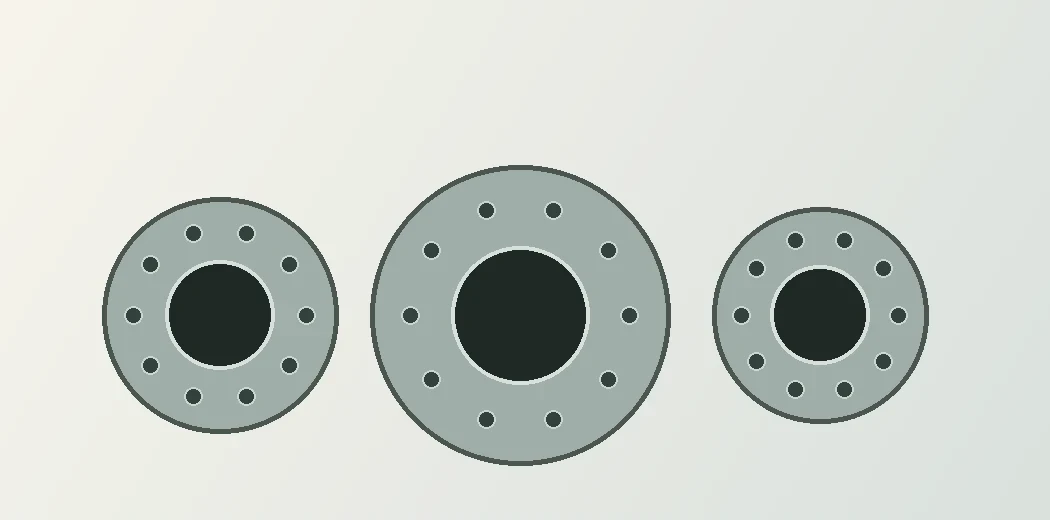
Choose a flange type
Each type links to dimensions, facings, classes and a product-specific enquiry.

Weld-Neck
RF · RTJ · Class 150–2500Tapered hub butt-welded to pipe; suited to high-pressure, cyclic and severe service.
View weld-neck flanges
Slip-On
RF · FF · Class 150–600Slides over the pipe and is fillet-welded; economical for lower-pressure lines.
View slip-on flanges
Blind
RF · RTJ · Class 150–2500Solid disc that closes a flanged opening or vessel nozzle.
View blind flanges
Socket-Weld
RF · Class 150–1500Small-bore high-pressure flange with a socket bore and fillet weld.
View socket-weld flanges
Threaded
RF · FFNPT-threaded flange for lines that cannot be welded.
View threaded flanges
Lap-Joint
With stub endLoose backing flange over a stub end; rotatable, economical in alloys.
View lap-joint flanges
Orifice
With tappingsFlange pair with pressure tappings for orifice-plate flow metering.
View orifice flanges
RTJ
Facing · ring-grooveRing-groove facing for metal ring-gasket sealing at high pressure/temperature.
View RTJ flangesTechnical specification
| Parameter | Specification |
|---|---|
| Product | Pipe flanges — weld-neck, slip-on, blind, socket-weld, threaded, lap-joint & orifice, with RF / FF / RTJ facing |
| Dimensional standard | ASME B16.5 (NPS ½–24) · B16.47 Series A/B (NPS 26–60) · B16.36 orifice; EN 1092-1 where specified |
| Classes | ASME Class 150–2500 (by standard, type & size; Class 2500 to NPS 12); PN to EN 1092-1 where specified |
| Facings | RF · FF · RTJ (facing & gasket selected for the service) |
| Size range | ½" – 60" NPS (type-specific limits apply; not every class in every size) |
| Material specifications | ASTM A105 / A105N, A350, A182, B564, B462 |
| Sour service | NACE MR0175 / ISO 15156 where specified |
| Documentation | EN 10204 3.1 / 3.2, PMI, TPI |
How it is made
Flanges are open- or closed-die forged from bar or billet, then heat treated to the grade requirement — carbon A105 as-forged or normalised; low-temp A350 normalised (and tempered) with Charpy testing; Cr-Mo A182 F-grades normalised & tempered; austenitic stainless solution annealed; duplex solution annealed and rapidly cooled. The face and facing are machined to the specified finish — a raised face (RF) to the specified serrated finish, or a ring-joint (RTJ) groove — and the bore, hub and drilling to the standard, type and class. Class denotes a pressure-temperature rating basis, not a pressure in psi, and the flange rating alone does not establish the rating of a complete bolted joint.
Grades & materials
Representative flange grades, with representative chemistry. Exact grade, class and condition are confirmed per order; availability is by verified capability — not every grade in every type, class and size.
| Material family | Grades | UNS | Standard | Service |
|---|---|---|---|---|
| Carbon steel | A105 (N = normalised) | K03504 | ASME B16.5 / ASTM A105 | General service |
| Low-temp carbon | A350 LF2 Cl.1/2, LF3, LF6 | — | ASTM A350 | Low temperature |
| Cr-Mo alloy | A182 F1, F11, F12, F22, F5, F9, F91, F92 | — | ASTM A182 | High-temperature |
| Austenitic stainless | A182 F304/304L/304H, F316/316L/316H, F321, F347, F317L, F44 (6Mo) | — | ASTM A182 | Corrosion / high temp |
| Duplex / super duplex | A182 F51 (S31803), F60 (S32205), F53 (S32750 / 2507), F55 (S32760) | — | ASTM A182 | Chloride / sour |
| Nickel alloys | B564 N06600 (600), N06625 (625), N04400 (Monel), N10276 (C-276), N08825 (825) | — | ASTM B564 | Severe corrosion |
| Alloy 20 | B462 N08020 | N08020 | ASTM B462 | Sulphuric acid |
Chemical composition (representative)
| Grade | C | Mn | Si | Cr | Ni | Mo | Other |
|---|---|---|---|---|---|---|---|
| A105 | 0.35 max | 0.60–1.05 | 0.10–0.35 | 0.30 max | 0.40 max | 0.12 max | Cu 0.40 max |
| A350 LF2 | 0.30 max | 0.60–1.35 | 0.15–0.30 | 0.30 max | 0.40 max | 0.12 max | — |
| A182 F11 Cl.2 | 0.05–0.15 | 0.30–0.60 | 0.50–1.00 | 1.00–1.50 | — | 0.44–0.65 | — |
| A182 F22 Cl.3 | 0.05–0.15 | 0.30–0.60 | 0.50 max | 2.00–2.50 | — | 0.87–1.13 | — |
| A182 F91 | 0.08–0.12 | 0.30–0.60 | 0.20–0.50 | 8.0–9.5 | 0.40 max | 0.85–1.05 | V 0.18–0.25, Nb 0.06–0.10, N 0.03–0.07 |
| A182 F304L | 0.030 max | 2.00 max | 1.00 max | 18.0–20.0 | 8.0–13.0 | — | — |
| A182 F316L | 0.030 max | 2.00 max | 1.00 max | 16.0–18.0 | 10.0–15.0 | 2.0–3.0 | — |
| A182 F51 (S31803) | 0.030 max | 2.00 max | 1.00 max | 21.0–23.0 | 4.5–6.5 | 2.5–3.5 | N 0.08–0.20 |
| A182 F53 (S32750) | 0.030 max | 1.20 max | 0.80 max | 24.0–26.0 | 6.0–8.0 | 3.0–5.0 | N 0.24–0.32 |
| A182 F44 (6Mo) | 0.020 max | 1.00 max | 0.80 max | 19.5–20.5 | 17.5–18.5 | 6.0–6.5 | N 0.18–0.25, Cu 0.5–1.0 |
| B564 625 | 0.10 max | 0.50 max | 0.50 max | 20.0–23.0 | 58.0 min | 8.0–10.0 | Nb 3.15–4.15 |
| B462 Alloy 20 | 0.07 max | 2.00 max | 1.00 max | 19.0–21.0 | 32.0–38.0 | 2.0–3.0 | Cu 3.0–4.0, Nb 8×C–1.0 |
Standards & specifications
Dimensional
- ASME B16.5 flanges NPS ½–24 (Class 150–2500; 2500 to NPS 12)
- ASME B16.47 Series A / B large-diameter flanges NPS 26–60
- ASME B16.36 orifice flanges
- EN 1092-1 steel flanges (PN / DN) where specified
Material & service
- ASTM A105 / A350 carbon & low-temp forgings
- ASTM A182 alloy, stainless & duplex forgings
- ASTM B564 / B462 nickel & Alloy 20
- ASME B16.20 / B16.21 gaskets; NACE MR0175 / ISO 15156 sour service by grade & condition
Mechanical properties (representative grades)
Representative grades — full MTC values on request. Values are ASTM/ASME specification minima or ranges at room temperature. Temperatures shown for low-temperature grades are impact-test temperatures, not guaranteed minimum service temperatures; the design temperature is set by the code, thickness and condition.
| Grade | Type | Tensile (MPa) | Yield min (MPa) | Elong min (%) |
|---|---|---|---|---|
| A105 / A105N | Carbon | 485 | 250 | 22 |
| A350 LF2 Cl.1 | Low-temp C (−46 °C) | 485–655 | 250 | 22 |
| A350 LF3 | 3½Ni (−101 °C) | 485–655 | 260 | 22 |
| A350 LF6 Cl.1 | Low-temp C-Mn | 440 min | 250 | 22 |
| A182 F1 | C-½Mo | 485 | 275 | 22 |
| A182 F11 Cl.2 | 1¼Cr-½Mo | 515 | 310 | 20 |
| A182 F12 Cl.2 | 1Cr-½Mo | 485 | 275 | 20 |
| A182 F22 Cl.3 | 2¼Cr-1Mo | 515 | 310 | 18 |
| A182 F5 | 5Cr-½Mo | 485 | 275 | 20 |
| A182 F9 | 9Cr-1Mo | 620 | 380 | 20 |
| A182 F91 | 9Cr-1Mo-V | 585 | 415 | 20 |
| A182 F92 | 9Cr-2W | 620 | 440 | 20 |
| A182 F304 / F304H | Austenitic SS | 515 | 205 | 30 |
| A182 F304L | Austenitic SS | 485 | 170 | 30 |
| A182 F316 / F316H | Austenitic SS | 515 | 205 | 30 |
| A182 F316L | Austenitic SS | 485 | 170 | 30 |
| A182 F317L | Austenitic SS | 515 | 205 | 35 |
| A182 F321 | Austenitic SS | 515 | 205 | 30 |
| A182 F347 | Austenitic SS | 515 | 205 | 30 |
| A182 F44 (6Mo) | Super-austenitic | 650 | 300 | 35 |
| A182 F51 (S31803) | Duplex | 620 | 450 | 25 |
| A182 F60 (S32205) | Duplex | 655 | 485 | 25 |
| A182 F53 (S32750) | Super duplex | 795 | 550 | 15 |
| A182 F55 (S32760) | Super duplex | 750 | 550 | 25 |
| B564 N06600 (600) | Ni-Cr | 550 | 240 | 30 |
| B564 N06625 (625) | Ni-Cr-Mo | 760 | 345 | 30 |
| B564 N04400 (Monel 400) | Ni-Cu | 480 | 170 | 35 |
| B564 N10276 (C-276) | Ni-Mo-Cr | 690 | 283 | 40 |
| B564 N08825 (825) | Ni-Fe-Cr | 585 | 235 | 30 |
| B462 N08020 (Alloy 20) | Ni-Fe-Cr-Mo | 551 | 241 | 30 |
Testing, inspection & documentation
| Test / document | Detail |
|---|---|
| Chemical / PMI | Product-analysis chemistry; PMI on alloy, stainless & nickel grades |
| Tensile | Tensile, yield and elongation per grade (ASTM A370) |
| Impact (Charpy) | A350 LF2/LF3/LF6 at the grade test temperature; and where specified |
| Hardness | Brinell/Rockwell; NACE MR0175 hardness for sour service (e.g. F22 ≤ 22 HRC) |
| Corrosion | IGC susceptibility per ASTM A262 practice as specified (austenitic); ferrite / phase check (duplex) |
| NDE | UT / MPI / DPT as specified; 100 % visual and dimensional |
| Certification | EN 10204 3.1 as standard; 3.2 where the contracted inspection responsibilities are met |
Applications & industries served
Available forms, sizes & range
Standard forms and the supply range for this family. Exact size, wall and grade are confirmed per order.
| Parameter | Range |
|---|---|
| Classes | ASME Class 150 – 2500 (by standard, type & size) |
| Size range | 1/2" – 60" NPS |
Frequently asked questions
Which flange type should I use?
Weld-neck suits high-pressure, cyclic and severe service; slip-on is economical for lower-pressure lines; blind closes an opening; socket-weld and threaded suit small-bore; lap-joint gives a rotatable alloy joint; orifice is for metering. The final choice depends on the design code, loads, service and joint design rather than a single “best” type.
Is ASME Class the same as psi?
No. ASME Class (150 to 2500) is a pressure-temperature rating designation, not a pressure in psi and not a mass. The allowable pressure falls as temperature rises and depends on the material group, so it is read from the pressure-temperature rating table for the standard, class and material.
What is the difference between ASME B16.5 and B16.47?
B16.5 covers flanges NPS ½ to 24 in Classes 150 to 2500 (Class 2500 to NPS 12). B16.47 covers large-diameter flanges NPS 26 to 60 in Series A and Series B, which have different drilling and dimensions and are not interchangeable. The available class depends on the standard, series, type and size — not every class extends to every size.
Is RTJ a flange type?
No. RTJ (ring-type joint) is a facing and sealing arrangement, not a construction type. Weld-neck, blind and other types can be supplied with an RF, FF or RTJ facing, and the facing and its gasket are selected for the pressure, temperature and service.
Do you supply EN 1092-1 flanges as well as ASME?
Where required, EN 1092-1 flanges are supplied identified by part, type number, PN, DN, material and facing. PN is not the same as an ASME Class and EN drilling is not interchangeable with ASME drilling, so the standard is confirmed per order.
What documentation and testing is provided?
EN 10204 3.1 as standard and 3.2 where the contracted third-party inspection responsibilities are met, with PMI, NDE and impact or hardness tests to the project ITP. A 3.2 certificate requires the defined inspection roles, not just an added stamp.
Request a quote
Send your requirement to Sagiant Piping Industries and our team responds with grade, material selection, availability and pricing for flanges. Attach a BOQ, line list or drawing for a faster, more accurate quotation.
- Fast RFQ response with grade & material-selection support
- EN 10204 3.1 / 3.2 certification, PMI & third-party inspection
- BOQ & line-list project supply — India & export
Mechanical & chemical values shown are ASTM/ASME specification figures; certified heat-specific values appear on the MTC. Availability is confirmed with the quotation.