Bars & Rods
Hot-rolled and bright (cold-finished) bars — round, square, hex and flat — in carbon, alloy, stainless and duplex grades. Stainless bar is supplied to ASTM A276 / A479, and engineering carbon and alloy steel to their own procurement and EN dimensional standards, for machining, fabrication and structural use.
Choose a bar section
Each section links to grades, tolerances, finish and a product-specific enquiry.
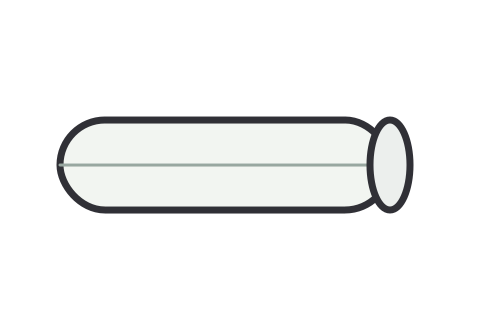
Round Bars
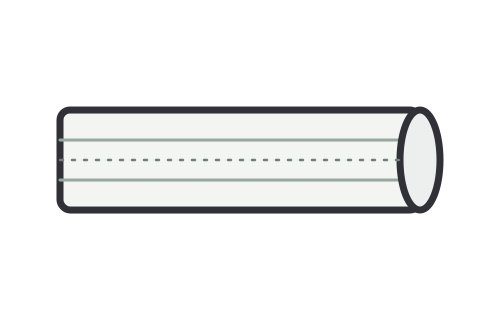
Hot-rolled & brightRound bar and rod for shafts, machining and fasteners.
View round bars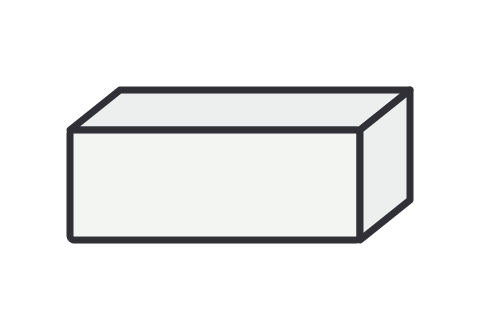
Square Bars
Hot-rolled & brightSquare bar for frames, fabrication and machining.
View square bars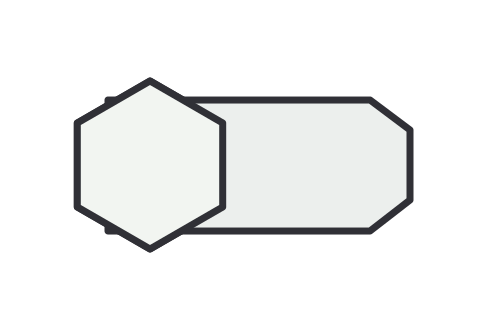
Hex Bars
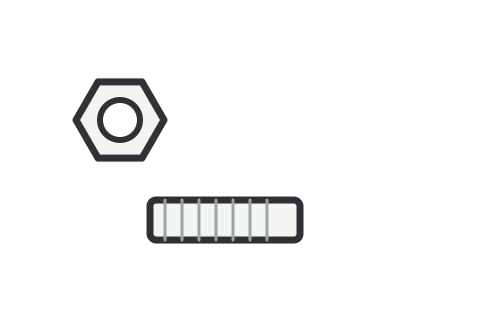
Bright, across-flatsHexagonal bar for fasteners, fittings and machined parts.
View hex bars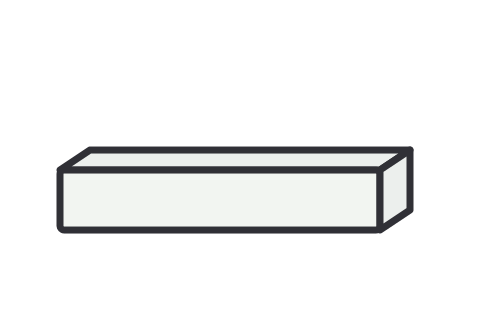
Flat Bars
Hot-rolledFlat bar for supports, brackets and fabrication.
View flat bars
Bright Bars
Finish · cold-drawn / groundCold-finished bright bar to close tolerance (h9/h11) and fine finish.
View bright barsTechnical specification
| Parameter | Specification |
|---|---|
| Product | Hot-rolled & bright (cold-finished) bars — round, square, hex, flat |
| Dimensional standard | EN 10060 (round) · 10059 (square) · 10058 (flat) · 10061 (hex) |
| Finish | Hot-rolled · cold-drawn · ground · peeled |
| Tolerance | h9 / h11 size-dependent limits (bright bar, EN 10278) · product-standard tolerance (hot-rolled) |
| Size range | 5 – 250 mm (by section: round dia, square / hex across flats, flat width × thickness) |
| Material specifications | Stainless ASTM A276 / A479 / A582 · EN 10088-3; carbon & alloy ASTM A29 (general req.) / A108 (cold-finished) · EN 10083; bright EN 10278 |
| Condition | Annealed · solution-annealed · hardened & tempered · cold-worked (by grade & product) |
| Documentation | EN 10204 3.1 / 3.2, PMI |
How it is made
Bars are hot-rolled or forged from bloom/billet, then optionally cold-finished — cold-drawn, centreless-ground or turned/peeled — for a close, size-dependent tolerance and a bright surface. Austenitic stainless is solution annealed and pickled; martensitic grades are annealed or hardened & tempered; free-machining 303 has a controlled sulphur addition for machinability. Carbon and alloy steels are supplied in the ordered condition — as-rolled, annealed, or hardened & tempered. Because carbon and alloy bar mechanicals depend on the heat-treatment condition and section size, those values are given as typical for the condition and confirmed on the MTC; austenitic and duplex stainless bar carry the applicable ASTM specification minima.
Grades & materials
Representative bar grades, with representative chemistry. Exact grade, condition and finish are confirmed per order; availability is by verified capability, and similar commercial names (for example EN19 / 4140) are not automatic substitutes.
| Material family | Grades | UNS | Standard | Service |
|---|---|---|---|---|
| Austenitic stainless | A276/A479 304, 304L, 316, 316L, 321, 310, 347 | — | ASTM A276 / A479 | Corrosion |
| Free-machining SS | A582 303 (S30300), 303Se (S30323) | — | ASTM A582 | Machined parts |
| Martensitic SS | A276 410, 420, 431 | — | ASTM A276 | Wear / strength |
| Duplex / super duplex | A276/A479 S31803 (2205), S32750 (2507) | — | ASTM A276 / A479 | Chloride / sour |
| Alloy steel | 4140, 4340, EN19, EN24 | — | ASTM A29 / EN 10083 | High strength |
| Carbon steel | EN8, EN9, 1045, EN1A (bright) | — | ASTM A29 / EN | General engineering |
| Nickel alloys | 625 (N06625), 718 (N07718) | — | ASTM B446 (625) / B637 (718) | Severe corrosion / high strength |
Chemical composition (representative)
| Grade | C | Mn | Cr | Ni | Mo | Other |
|---|---|---|---|---|---|---|
| A276 304 | 0.08 max | 2.00 max | 18.0–20.0 | 8.0–10.5 | — | — |
| A276 316 | 0.08 max | 2.00 max | 16.0–18.0 | 10.0–14.0 | 2.0–3.0 | — |
| A582 303 | 0.15 max | 2.00 max | 17.0–19.0 | 8.0–10.0 | — | S 0.15 min |
| A276 410 | 0.08–0.15 | 1.00 max | 11.5–13.5 | — | — | — |
| A276 S31803 (2205) | 0.030 max | 2.00 max | 21.0–23.0 | 4.5–6.5 | 2.5–3.5 | N 0.08–0.20 |
| 4140 (alloy) | 0.38–0.43 | 0.75–1.00 | 0.80–1.10 | — | 0.15–0.25 | — |
Standards & specifications
Dimensional & product
- EN 10060/10059/10058/10061 round/square/flat/hex
- ASTM A276/A479 stainless bars
- ASTM A582 free-machining SS
- ASTM A29 (general req.) / A108 (cold-finished) · EN 10083 carbon & alloy
Finish & tolerance
- Hot-rolled or bright (cold-drawn / ground / peeled)
- Bright bar to EN 10278 — h9 / h11 size-dependent limits
- Straightness, roundness & surface roughness per order
- Condition (annealed / hardened & tempered) per grade
Mechanical properties (representative grades)
Representative grades — full MTC values on request. Stainless and duplex values are ASTM specification minima; carbon and alloy values are typical for the stated condition and section and are confirmed on the MTC, not guaranteed minima.
| Grade | Condition | Tensile (MPa) | Yield min (MPa) | Elong min (%) | Hardness |
|---|---|---|---|---|---|
| 304 / 304L | Annealed | 515 / 485 | 205 / 170 | 40 | ≤ 201 HBW |
| 316 / 316L | Annealed | 515 / 485 | 205 / 170 | 40 | ≤ 217 HBW |
| 321 | Annealed | 515 | 205 | 40 | ≤ 217 HBW |
| 310 | Annealed | 515 | 205 | 40 | ≤ 217 HBW |
| 347 | Annealed | 515 | 205 | 40 | ≤ 201 HBW |
| 303 (free-machining) | Annealed | 515 | 205 | 35 | ≤ 262 HBW |
| 410 | Annealed | 450 | 205 | 20 | ≤ 217 HBW |
| 410 | Q & T | 620 | 415 | 15 | — |
| 431 | Q & T | 795 | 620 | 15 | — |
| S31803 (2205) | Solution annealed | 620 | 450 | 25 | ≤ 293 HBW |
| S32750 (2507) | Solution annealed | 795 | 550 | 15 | ≤ 310 HBW |
| 1045 carbon | Hot-rolled (typical) | 570–700 | 310 | 16 | 170–210 HBW |
| 4140 alloy | Q & T (typical) | 850–1000 | 650 | 12 | 28–34 HRC |
| 4340 alloy | Q & T (typical) | 930–1080 | 740 | 10 | 30–36 HRC |
Testing, inspection & documentation
| Test / document | Detail |
|---|---|
| Chemical / PMI | Composition to the spec; PMI on stainless/alloy |
| Tensile | Tensile, yield and elongation per grade/condition |
| Hardness | Brinell/Rockwell per grade and condition |
| Corrosion | IGC susceptibility per the specified ASTM A262 practice (austenitic); duplex phase / corrosion test where specified |
| Dimensional / identity | Section size, straightness, surface & heat / lot identity |
| Ultrasonic | UT to an agreed class, sensitivity & acceptance for larger sections where required |
| Certification | EN 10204 3.1 as standard; 3.2 where the contracted inspection responsibilities are met |
Applications & industries served
Available forms, sizes & range
Standard forms and the family supply envelope. Exact section dimensions, length, finish, condition and grade are confirmed per order; the range below is by section, not a per-shape capacity.
| Parameter | Range |
|---|---|
| Sections | Round · square · hex · flat |
| Finish | Hot-rolled & bright (cold-finished) |
| Size range | 5 – 250 mm (by section) |
Frequently asked questions
What is a bright bar?
A cold-finished bar — cold-drawn, ground or turned/peeled — giving a close, size-dependent tolerance (typically h9 / h11) and a bright, smooth surface for direct machining or fitting. Bright is a finish, not a grade, and does not by itself change the metallurgical condition.
Which sections and finishes do you supply?
Round, square, hexagonal and flat sections, in hot-rolled or bright (cold-finished) form, across carbon, alloy, stainless and duplex grades. Hex is specified across flats and flat bar by width × thickness.
What tolerances apply to bright bar?
Bright bar is supplied to EN 10278 with h9 / h11 limits that depend on the size — h9 / h11 is a tolerance designation, not a roughness or straightness figure. Straightness, roundness and surface finish are agreed separately per order.
Why does the delivery condition matter?
For carbon and alloy steel the strength and hardness come from the heat-treatment condition (as-rolled, annealed, or hardened & tempered) and the section size, not from the grade alone. We confirm the condition and section-specific properties per order; catalogue carbon and alloy figures are typical, not guaranteed minima.
Are EN19 / EN24 and 4140 / 4340 interchangeable?
They are closely related, but EN19 and 4140, or EN24 and 4340, are not automatic substitutions. The procurement standard, chemistry, section, condition and test requirements are compared and confirmed against the order before a substitution is accepted.
How is bar weight calculated?
Theoretical mass uses the section area and the grade's density — for a round, kg/m = π·d²·ρ / (4×10⁶) with d in mm; a hex uses the across-flats dimension. These are ideal-section estimates, so corner radii, tolerance, scale and finish affect the actual mass, and a calculated weight is not a confirmation of stock.
Request a quote
Send your requirement to Sagiant Piping Industries and our team responds with grade, material selection, availability and pricing for bars & rods. Attach a BOQ, line list or drawing for a faster, more accurate quotation.
- Fast RFQ response with grade & material-selection support
- EN 10204 3.1 / 3.2 certification, PMI & third-party inspection
- BOQ & line-list project supply — India & export
Mechanical & chemical values shown are ASTM/ASME specification figures; certified heat-specific values appear on the MTC. Availability is confirmed with the quotation.